


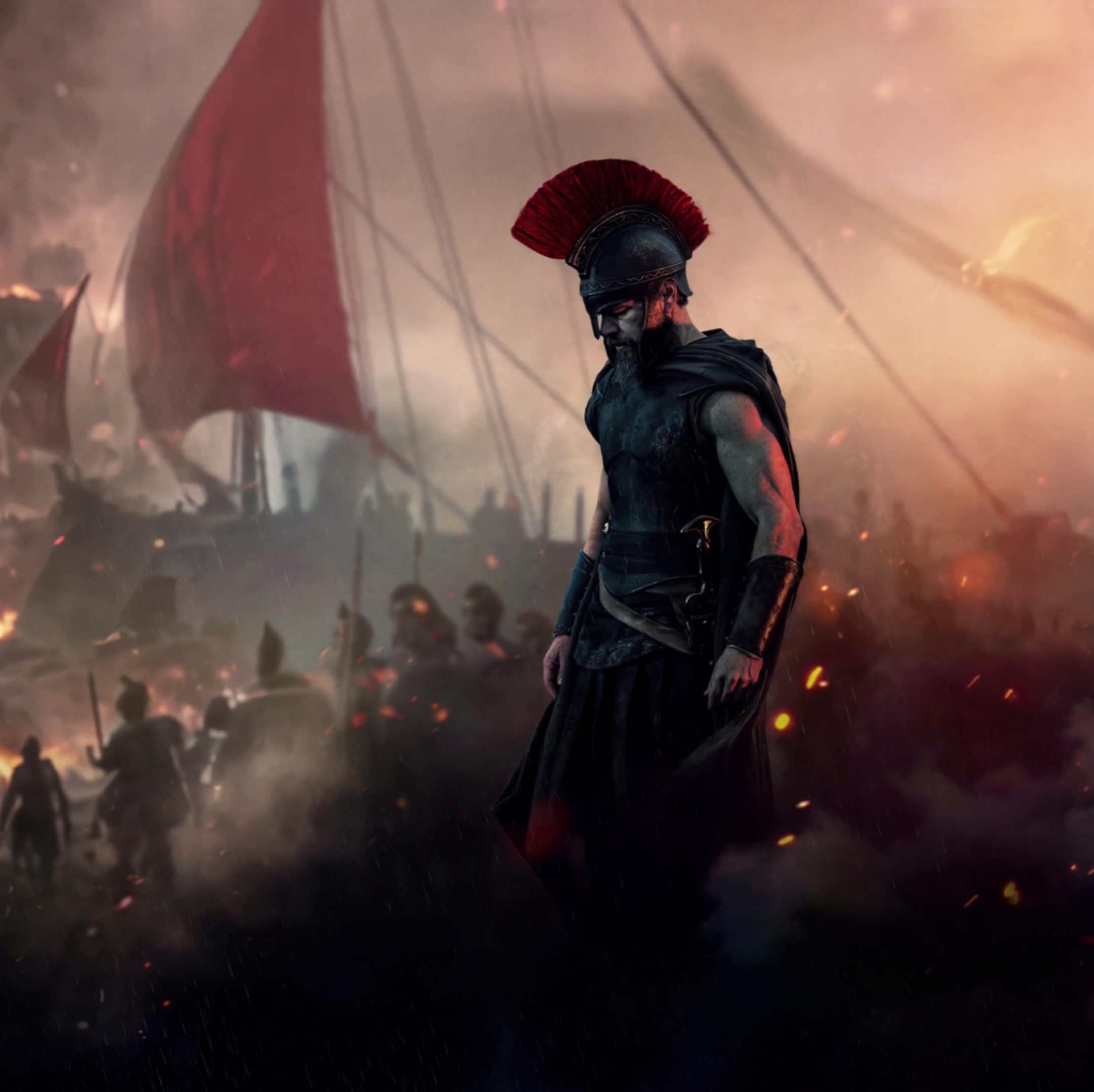
By: Rabbi Jess Minnen
These days we tend to encounter classic texts as adaptations, if we encounter them at all. But for me, Christopher Nolan’s The Odyssey actually succeeded before I ever saw it because it sent me back to its source: I decided to read a three-thousand-year-old epic poem from the oral tradition of ancient Greece, attributed to a figure called Homer, though historically it was most likely the product of many voices.
That decision probably requires some explanation. I wasn’t preparing for a class. There wasn’t going to be a test. I’m a rabbi, a working mother, and like everyone else I have far more books I want to read than time to read them. Why spend precious hours with Homer?
Judaism has an answer to that question. We call it Torah lishmah, “learning for its own sake.” We study not because a text is immediately useful, but because great texts shape the people who linger with them. We learn not simply to understand a text, but to be understood by it. We trust that if we stay with it long enough, it will begin asking something of us.
So I did what Jews have always done when they decide a text is worth taking seriously: I opened the book. Almost immediately, I ran into the first question every reader of Homer must answer. Which translation?
I assumed I was searching for the most accurate translation. It didn’t take long to realize that accuracy offered no safe harbor. Anyone who studies Torah knows this instinctively. Every translation is already an interpretation. There is no such thing as a neutral rendering of a text. Every translator decides which meanings to privilege, which ambiguities to resolve, and which rhythms to sacrifice. A single Hebrew word can carry half a dozen meanings, or compress layers of significance that no single English word can fully convey.
The same is true of ancient Greek. The Odyssey is written in dactylic hexameter, a rolling six-beat line built on the length of syllables rather than the stress patterns familiar to English. Its music lives in alliteration, assonance, and echoes of oral performance. None of that survives intact in English.
Eventually I found myself drawn to Daniel Mendelsohn, first by the prose, then by the man behind the translation. His memoir An Odyssey tells the story of reading Homer with his elderly father, turning the poem into a havruta text, debating their way toward understanding. Then I picked up Mendelsohn’s The Lost: A Search for Six of Six Million. Mendelsohn reconstructs the lives of six relatives murdered in the Holocaust. It is a profoundly Jewish book because it understands that memory itself must be translated. Each generation inherits fragments of the past and bears responsibility for passing them on. That was the commitment I wanted from a translator.
Somewhere between Homer and Mendelsohn, I realized I had begun excavating again. My graduate work was in ancient Near Eastern culture, and for years I lived in the slow scholarship of reconstructing civilizations from papyrus and potsherds. Reading Homer returned me to that world. But I was no longer the same reader. Twenty years ago, I kept Homer and Torah on separate shelves. This time I found myself reading them in conversation. Though born of different traditions, the two ask strikingly similar questions. Both interrogate memory. Both wrestle with covenant and kingship, exile and redemption, and the obligations we owe to one another and to powers greater than ourselves.
Civilizations do not develop in isolation. They trade, migrate, wage war, and borrow from one another. Greeks and Israelites, living around the same sea in the same age of upheaval, grappled with many of the same questions. The Greeks gave one of those questions a name: nostos. We inherit the English word “nostalgia” from it, but nostos means something much more concrete: “return home.”
The Odyssey belongs to a larger cycle of poems known as the Nostoi, stories of Greek heroes struggling to make their way home after the Trojan War. But Troy and Ithaca are only 565 nautical miles apart. Under ordinary conditions, a Bronze Age voyage would have taken only a few weeks. Clearly, this is no ordinary voyage.
There is an old Yiddish saying: Mann tracht, un Got lakht, “Man plans, and God laughs.” The same intuition appears in Proverbs 16:9: “The human mind plans the way, but God directs the steps.” The Greeks recognized the same truth. Odysseus is brilliant, courageous, and resourceful. None of that guarantees a straight path or a safe return. Again and again, his plans are thwarted by forces beyond his control. We find a similarly fraught journey in Torah. The distance from Egypt to Canaan could have been covered in a matter of weeks. Instead, it takes 40 years. Torah is no more interested in efficient travel than Homer is.
When Odysseus finally leaves the forgetful haze of Kalypso’s embrace, she tells him that if he truly wishes to return home, he must entrust himself to the gods. It is a startling moment that acknowledges the limits of human agency. There comes a point when strategy is no longer enough. He has outwitted monsters and placated sorceresses. He has resisted temptation and succumbed to it. He has lost every ship. Every companion. Every certainty. He carries the terror of Troy with him. The man who returns to Ithaca is not the man who left it.
Through this revelation, a deeper meaning of nostos emerges. It is not simply the act of returning home. It is the discovery and acceptance of the self who returns. Who have I become? Will the people waiting for me still know me? Will they still welcome me home?
Travel itself was an act of profound dependence. Survival depended on the willingness of a stranger to open their home to you. That willingness required extraordinary trust. You had to believe that the person opening the gate would not rob you, enslave you, or kill you. The host, in turn, had to believe that the stranger would not do the same. On that fragile act of mutual vulnerability, civilization itself depended.
The Greeks called this covenant of hospitality xenia. The host owed the stranger water, food, shelter, protection, and safe passage. Guests, in turn, owed gratitude, restraint, and respect for the household that had welcomed them. Watching over this covenant was Zeus Xenios, Zeus in his role as protector of strangers. In Nolan’s film, one character explains that “Zeus’s Law” exists because any stranger might be a god in disguise. To violate xenia was not simply to offend another person. It was to risk offending the gods themselves.
Homer tests this obligation repeatedly. Odysseus and his companions arrive in the land of the Cyclopes as strangers seeking food and shelter. Polyphemus is monstrous not because of his gigantic form or his single eye, but because he rejects every obligation that civilization demands. He offers no welcome, no water, no meal, no protection. Instead, the guest who should have been fed becomes the food.
As this pattern unfolds throughout the epic, I found myself returning to Genesis, where the Torah arrives at a remarkably similar ethic by a different theological path. Every human being is created b’tzelem Elohim, in the image of God. The stranger is not God in disguise. The stranger bears the divine image openly. To receive another human being is, in a sense, to receive God.
In Genesis 18, Abraham sits at the opening of his tent in the heat of the day, vulnerable. Yet when he sees three strangers approaching, he runs toward them. Before Abraham knows who they are, he knows how he must treat them. We call this practice hachnasat orchim, welcoming guests. Like xenia, it is far more than etiquette. It is a way of organizing society around the conviction that every human being possesses inherent dignity and is worthy of care.
Reading The Odyssey through the lens of Genesis, I began to understand the Trojan Horse differently. For most of my life, I had understood it as a symbol of ingenuity, however deceptive. The triumph of intelligence over brute force. Nolan refuses that reading. His sack of Troy is not conquest. It is annihilation. The Trojan Horse changes warfare forever. It succeeds because it exploits something far older than technology. It exploits trust.
The true horror of the Trojan Horse is that the institution that makes civilization possible becomes the instrument of its destruction. If the Horse succeeded because the Trojans were foolish, the lesson would be simple: don’t be foolish. But that isn’t the story. The Horse succeeds because the Trojans act in accordance with one of civilization’s deepest moral instincts.
How, then, can Odysseus return home after serving as the architect of such destruction?
Roped to the mast of his ship, Odysseus survives hearing the song of the Sirens. He screams in agony, a visceral portrait of emotional terror. The Sirens force him to confront what he most fears: not the journey home, but the possibility that he has become someone unworthy of home.
Judaism has a name for this kind of return. We call it teshuvah. The word is often translated as “repentance,” but its literal meaning is “return.” Every year, in the weeks leading up to Rosh Hashanah and Yom Kippur, we prepare for that return. We examine ourselves. We reckon with the ways we have become estranged from God, from one another, and from ourselves. At its deepest level, teshuvah asks whether we can find our way back home.
Like Odysseus, we cannot make that journey without confronting monsters. We call this work heshbon ha’nefesh, an “accounting of the soul.” We descend into the parts of ourselves we would rather avoid: resentments and failures, fears and regrets. Odysseus journeys to the underworld to seek wisdom from the dead. On Yom Kippur, we wear white, refrain from food and physical comforts, and contemplate our mortality. Both traditions understand that there are truths we can encounter only by passing through darkness.
Teshuvah cannot promise that we will become the person we once were. It asks whether we can live truthfully with the person we have become, repair what can be repaired, and move forward with greater humility and compassion. The promise of teshuvah is not that the past disappears. It is that the possibility of return remains.
When the theater lights came up and people filed out, I caught snippets of conversations about performances, practical effects, and historical accuracy. My thoughts had wandered elsewhere: to Bronze Age trade routes and the Sea Peoples, to Daniel Mendelsohn and Genesis 18, to nostos and teshuvah circling the same mystery from different shores.
The Odyssey reminded me that Jewish learning doesn’t teach us what to read. It teaches us how to read. Some traditions ask us to master texts. Judaism asks us to return to them. And we never return unchanged.
Continue the Journey
- Robert Alter, The Hebrew Bible: A Translation with Commentary (W. W. Norton, 2018).
- Daniel Mendelsohn, The Odyssey (University of Chicago Press, 2026).
- Daniel Mendelsohn, An Odyssey: A Father, a Son, and an Epic (Alfred A. Knopf, 2017).
- Daniel Mendelsohn, The Lost: A Search for Six of Six Million (HarperCollins, 2006).
- Christopher Nolan, The Odyssey (Universal Pictures, 2026).
- Emily Wilson, The Odyssey (W. W. Norton, 2017).